Key Takeaways
- Additive manufacturing (AM), commonly known as 3D printing, is emerging as a promising method to produce certain EWIS components.
- Modern printers are already capable of producing high-quality connector bodies to replace custom injection-molded parts.
- AM introduces a high number of process parameters that must be consistently controlled and validated.
Introduction
Electrical Wiring Interconnection System (EWIS) is the amalgamation of wires, cables, connectors, and support hardware that connect aircraft components. For most aircraft, the bulk of these standardized parts are produced by component manufacturers and qualified by the OEM and/or independent body (e.g., NAVAIR QPL). Additive manufacturing (AM), commonly known as 3D printing, is emerging as a promising method to produce certain EWIS components. This technology offers design freedom to create complex, lightweight structures and the ability to manufacture low-volume or custom parts without expensive tooling.
In this article, Lectromec explores which EWIS parts can be built with AM, reviews FAA guidance on qualifying AM parts, discusses current process control standards, and examines the challenges identified with 3D-printed aerospace components.
EWIS components suitable for AM
A 3D-printed connector mounting holder for an aerospace wiring harness is an example of how additive manufacturing can produce custom EWIS hardware. The holder shown here was designed by TE Connectivity for their D369 electrical connectors at the request of an aircraft manufacturer, and it had to be printed from a flame-retardant polymer with high accuracy (± 0.002 inch) to meet aerospace requirements. This accuracy and repeatability are necessary for connectors mating reliably and ensuring that environmental seals hold.
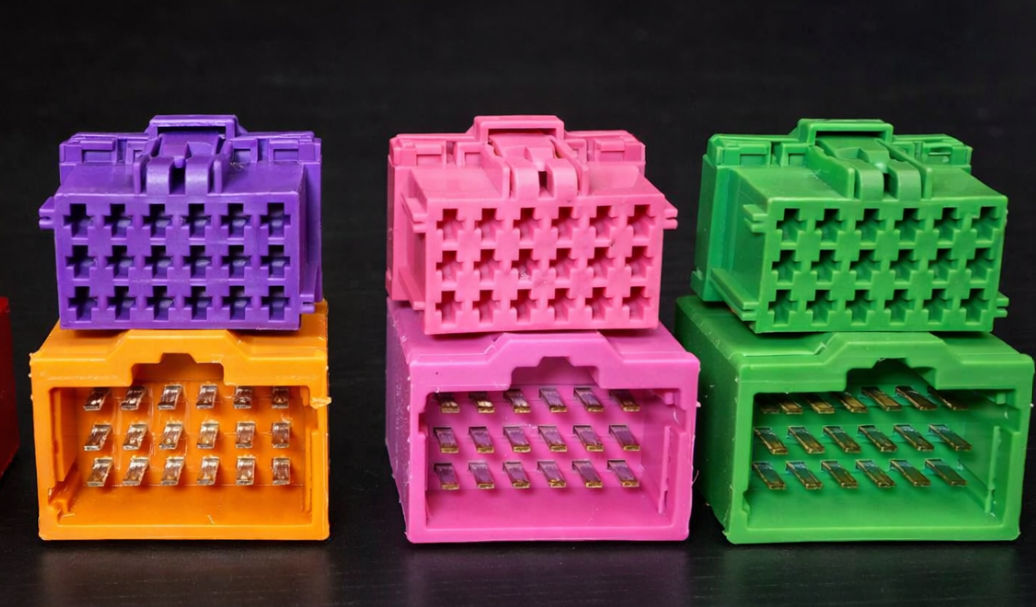
Connectors and connector housings are prime candidates for AM because they are often made of high-performance plastics and require geometry that lends itself to customization. The printed connector bodies are still fitted with standard metal pins or contacts after print, as the AM process does not work well for complex conductive parts. Other EWIS hardware — clamps, wire supports, custom routing brackets, or backshells — can also benefit from AM when engineers need rapid iterations or when the program requires a handful of bespoke parts rather than full production runs.
FAA approach to AM qualification
The FAA’s guidance memos focus on process control and validation methods as part of the means of compliance. Applicants must explain how they will consistently produce parts that meet specifications and how they will validate the AM process through coupon testing, microstructure analysis, and similar methods. Existing rules for materials, fabrication methods, strength, and safety still apply—there are no relaxed requirements for AM—so additional scrutiny is applied via policy memos and issue papers to ensure novel AM methods are rigorously qualified before acceptance.
“Existing regulations were written broadly enough to cover new processes. The burden is on applicants to prove AM parts meet the same safety bar.” — FAA Order 8110.4C
Process controls for additive manufacturing
One of the critical aspects of qualifying AM parts is demonstrating robust process control. Unlike traditional manufacturing, additive processes involve an unusually high number of variables. A laser powder bed fusion process, for example, may have over 100 adjustable parameters that influence the final part. Key variables include laser power and scan speed, layer thickness, hatch spacing and scan patterns, the build chamber atmosphere and temperature, and powder feed rate.
Guidance emphasizes that the manufacturer must identify and control the parameters that significantly influence part quality. This often means validating the process at the minimum and maximum values of each critical parameter. FAA AC 33.15-3 for engine parts states that any process parameters impacting the chemical, metallurgical, dimensional, or mechanical properties of the part should be treated as critical variables with allowable ranges and monitoring to ensure compliance.
Another cornerstone is a well-defined process specification. FAA Order 8110.4C requires approved process specifications for fabrication methods needing close control. For AM, this specification should document the machines, materials, environmental controls, inspection methods, acceptance criteria, and records of process qualification so that conforming parts can be produced repeatedly.
Conclusion
Additive manufacturing of EWIS components is an exciting development at the intersection of modern 3D printing and aircraft wiring systems. Parts like connector housings, wire clamps, and custom harness brackets can now be printed with optimized designs and produced on demand without special tooling. The FAA has signaled openness to these innovations provided companies thoroughly qualify AM parts under existing regulations.
Current FAA guidance underscores the need for robust process specifications and highlights that quality must be built into the additive process just as it is for conventional methods. Early use cases have shown the feasibility—as well as the challenges—of AM. Numerous printed parts are already flying, especially less critical ones, but the industry continues to address hurdles with consistency, inspection, and material behavior through ongoing research. For organizations looking to test AM or conventional EWIS parts, contact Lectromec; our ISO 17025:2017 accredited lab is ready to help.

Michael has been involved in the field of EWIS for more than two decades and has worked on a wide range of projects from basic component testing, aircraft certification, and remaining service life assessments. He is an FAA DER with delegated authority covering EWIS certification and the former chairman of the SAE AE-8 committee.